
Trackday & Racing — US
MotoAmerica Suit Rules: Certification Standards Explained
FIM's technical rules, which MotoAmerica racing follows, specify EN 17092 Class AAA or AA certification for suits in its top classes. These are public, technical certification requirements. Separately, MotoAmerica requires licensed competitors specifically to display official series sponsor logos on their leathers, a real but entirely different requirement that only applies to registered competitors, not something a third-party suit maker can offer as a general design option.
By NFmoto Technical Team · Last updated 26 July 2026 · 3 min read
"MotoAmerica suit rules" actually covers two genuinely different kinds of requirement, and it's worth separating them clearly: general suit certification standards, which are public, technical, and apply regardless of which series a rider competes in, and MotoAmerica's own specific competitor requirements, including mandatory sponsor branding, which apply only to registered, licensed competitors in the actual championship.
The Certification Standard: FIM's Technical Rules
MotoAmerica racing operates under FIM (Fédération Internationale de Motocyclisme) sanctioning alongside the AMA, and FIM's own Track Racing Technical Rules specify that race suits in its Supersport and Superstock classes must meet EN 17092 Class AAA or AA certification, the same European garment standard covered in our CE certification guide. In practice, Class AAA has effectively become the default expectation across serious road racing generally, since it represents the highest abrasion-resistance tier available under the standard, and many organisers simply require it outright rather than accepting the lower AA tier. This certification requirement is public information, published as part of FIM's own technical regulations, and applies as a baseline standard rather than being specific to any one team or sponsor.
FIM's Technical Rules specify EN 17092 Class AAA or AA. Class AAA has effectively become the default expectation across serious road racing generally.
A Separate, Real Requirement: Mandatory Sponsor Branding
Separately from certification, MotoAmerica's own published competitor FAQ confirms that registered competitors' leathers must display the series' own sponsor logos (MotoAmerica, Dunlop, and any designated series partner) at a specified minimum size. This is a real, genuine requirement, but it's specific to actual registered competitors in the championship, governed by MotoAmerica's own competitor agreements, not a general design option available to a suit maker working with a rider who isn't registered in that specific championship. A custom suit built for track use or club racing outside MotoAmerica's own series has no obligation, and generally no basis, to carry MotoAmerica's own series branding.
Mandatory sponsor branding applies only to registered, licensed competitors. A club-racing or trackday suit outside MotoAmerica has no obligation to carry it.
The Licensing Route Into MotoAmerica
Competing in MotoAmerica road racing events requires holding an AMA/FIMNA Road Racing licence specifically, obtained directly through the American Motorcyclist Association rather than through MotoAmerica itself. This is a separate step from simply buying certified gear. The licensing pathway, eligibility criteria, and application process are all handled through the AMA's own Racing Department, and confirming current requirements directly with the AMA is the reliable route for anyone at the stage of pursuing an actual competition licence, as opposed to trackday or club-level riding.
What This Means for a Custom Suit Order
Are you a registered MotoAmerica competitor?
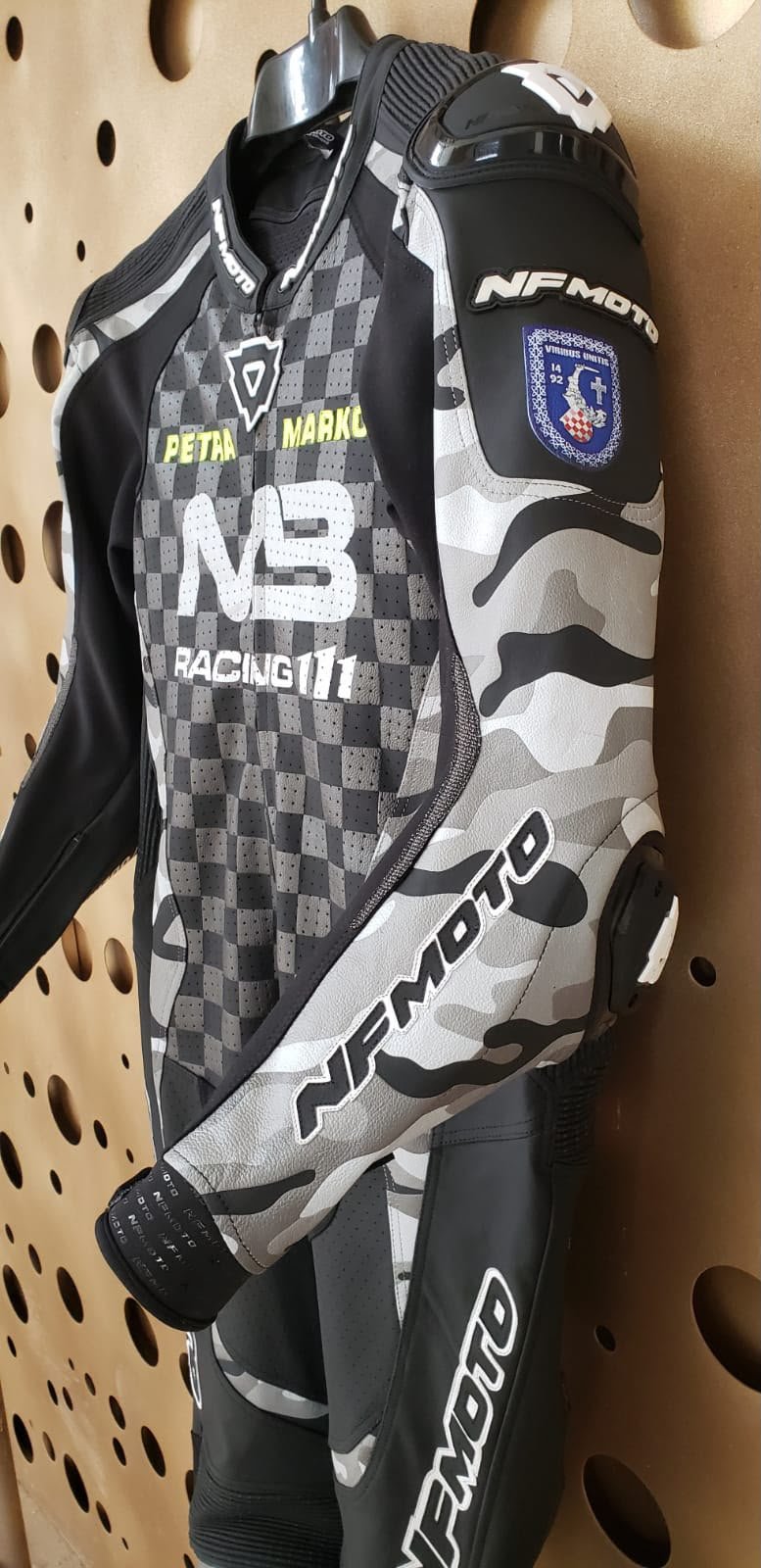
For a rider genuinely registered to compete in MotoAmerica, the practical takeaway is straightforward: order a Class AAA certified suit, and separately confirm the current season's specific sponsor branding requirements and logo files directly through MotoAmerica's own registration and competitor resources, since these can change between seasons and by class.
For a rider not registered in MotoAmerica specifically (a club racer, trackday rider, or someone competing in a different series entirely) the relevant standard is simply the general Class AAA certification, without any obligation to display MotoAmerica's own branding. A rider genuinely wanting a MotoAmerica-inspired aesthetic for their own suit, without being a registered competitor, is in the same position covered in our guide to BSB-inspired designs. An original design drawing on general racing visual language is achievable; reproducing a specific series' actual trademarked branding without authorisation isn't.
Certification Requirements Can Vary by Class
It's worth noting that MotoAmerica runs multiple distinct classes (Superbike, Supersport, Super Hooligan, and others), and technical requirements, including gear specifications, aren't necessarily identical across all of them. A class built around production-based machines can have different technical priorities than a full prototype-adjacent Superbike class. Rather than assuming one universal suit requirement applies across every MotoAmerica class, checking the current season's specific technical regulations for the exact class being entered, published directly through MotoAmerica's own registration site, is the reliable way to confirm what's actually required for that specific class in that specific season.
Common Questions
What certification does a MotoAmerica-eligible suit need?
Do I need MotoAmerica's own sponsor logos on my custom suit?
Is the certification requirement the same across every MotoAmerica class?
Can I get a MotoAmerica-style design without being a registered competitor?
Who do I contact for the current sponsor logo files if I am a registered competitor?
Can NFmoto build a Class AAA suit for MotoAmerica competition?
Continue Reading
Want to Check Real Certificates?
View and download NFmoto's actual CE certification documents before you order.